
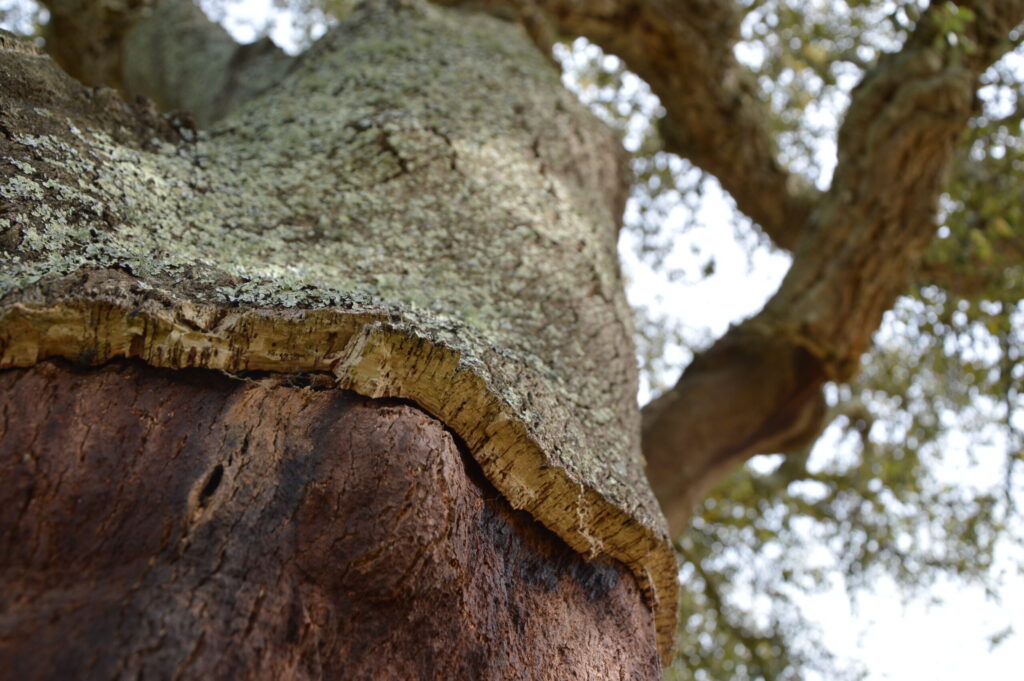
Cork is the bark of the cork oak tree (Quercus suber L). It is a 100% natural raw material, meaning 100% reusable and 100% recyclable, extracted from cork oaks without harming the environment and without damaging the trees.
Once processed, into stoppers for example, cork can re-enter the production process. The granules resulting from this process can be used as a huge variety of products, such as hot pads, yoga blocks, lamps or toys.
The 40 million cells in each cubic centimeter of cork act as a real decibel absorber, making it an excellent sound and vibration insulator. Its molecular structure allows it to absorb heat and retain it for a long period of time.
Almost over 50% of its volume is air, which makes it very light
The slow combustion of cork makes it a natural fire retardant and a kind of barrier against fires. Cork burns without a flame and does not emit toxic gases during combustion.
It can be compressed to around half its thickness without losing any flexibility, and it decompresses, recovering its initial shape and volume, as soon as it ceases to be compressed. This flexibility is given by its airtight cells containing a gas mixture similar to air. It is the only solid that when compressed on one side does not increase in volume on the other axis. It is able to adapt to variations in temperature and pressure without suffering variations, due to its elasticity.
It is totally impermeable to liquids and practically impermeable to gases, thanks to the suberin and cerin present in the composition of cork cells. Its resistance to moisture allows it to grow old without deteriorating.
Because cork does not absorb dust, it helps protect against allergies and does not pose a risk to asthma sufferers.
Main component of the cell walls, responsible for the elasticity of the cork
Insulating compound
Components of the cell walls that help define the texture of the cork
Polyphenolic compounds responsible for the colour
Hydrophobic compounds that guarantee the impermeability of the cork